

UCL and GOSH gene therapy ‘completely changes life’ for first teen patient
The first-ever patient with the rare immunodeficiency CGD has been successfully treated at Great Ormond Street.

The first-ever patient with the rare immunodeficiency p47 Chronic Granulomatous Disease has been successfully treated by a team at Great Ormond Street Hospital for Children NHS Foundation Trust (GOSH) and the UCL Great Ormond Street Institute of Child Health (UCL GOSH ICH).
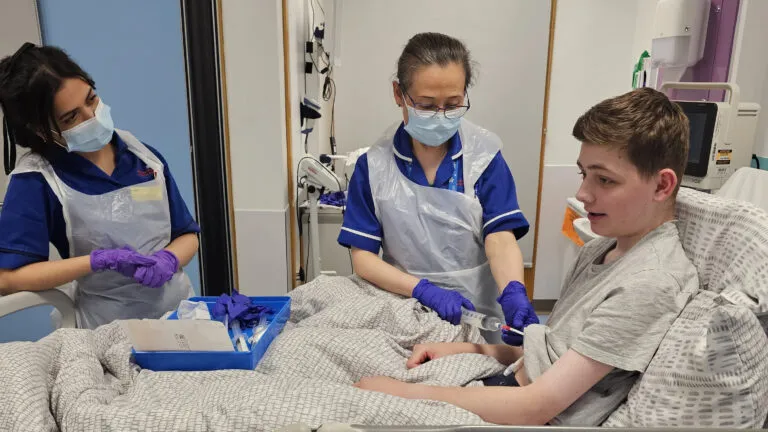
CGD leaves patients vulnerable to severe infection and inflammation. Remi Pereszczak, aged 19, has described how the therapy has ‘completely changed my life’ after being the first person to receive it as part of the clinical trial at Great Ormond Street Hospital for Children. Following treatment, Remi has been able to resume his studies and is preparing to begin university.
The new gene therapy is the first clinical trial in the world for patients with the p47 type of CGD. Remi was the first patient to receive this gene therapy in 2024 and the trial will treat five patients in total.
UCL Ventures' ‘UCL Technology Fund’, managed by Albion VC, funded the development of the vector used to deliver the gene therapy, preclinical testing, and ongoing clinical trial of this breakthrough therapy.
Remi was diagnosed with CGD in 2007 and had been waiting for a bone marrow transplant match when he found out about this trial.
“Before the trial I became really unwell and was struggling with my weight due to inflammation in my gut. I had been missing a lot of school, and even when doing online studies it was hard to focus when I was at hospital.”
He added: “Having the gene therapy has completely changed my life. I can go out and about now without worrying, help my family out and I’m excited to start university and start the next stage of my life.”
In the year since receiving the treatment, Remi has passed his driving test and finished his A-levels, which he previously had to put on hold. He has now secured a place at university to study law.
Professor Claire Booth, Mahboubian Professor in Gene Therapy at UCL Great Ormond Institute of Child Health and Consultant in Paediatric Immunology at GOSH, who led the clinical trial said: “This is a significant step forward. It means that future gene therapies developed at GOSH could reach clinical trials, and patients with rare diseases like Remi, faster than ever before.”
This achievement underscores the importance of UCL’s technology transfer expertise, combined with Technology Funds’ capital investment, ensuring that innovations in the laboratory can be brought to patients with rare diseases as swiftly and effectively as possible.
About p47 CGD
The p47 gene therapy was also the first product to be researched, manufactured and delivered to patients ‘under-one-roof’ at the Zayed Centre for Research Into Rare Disease in Children, run jointly by Great Ormond Street Hospital and UCL. First, a team of researchers at the UCL Great Ormond Street Institute of Child Health, led by Professor Adrian Thrasher and Dr Georgia Santilli, researched and developed the p47 CGD gene therapy.
P47 CGD is an inherited genetic immunodeficiency disorder that affects about one in a million people. People with this condition have immune systems that do not function properly, leaving them susceptible to inflammation and frequent bacterial and fungal infections.
CGD can lead to severe life limiting conditions such as colitis, inflammatory bowel disease and inflammatory complications and in some cases can be life threatening due to the risk of severe infections. The current treatment option is a bone marrow transplant, but finding a matched donor is challenging. Previous trials into gene therapy for a different form of CGD called X-CGD have been successful, but there had been no trials for p47 CGD.
Gene ‘tricked’
In order to deliver the gene therapy to a patient, a viral vector is needed. A viral vector is a harmless virus that can be used to ‘trick’ cells into accepting new genes. They are highly complex to make, and their availability and effectiveness dictates whether a clinical trial of gene or cell therapy will work.
In 2023, GOSH received an MHRA licence to manufacture viral vectors in the Zayed Centre, a pioneering institute for research that combines expertise of GOSH and UCL.
Once the gene therapy had been manufactured, strict quality assurance checks had taken place, the treatment was handed over to the clinical trial delivery team who are responsible for administering the gene therapy to the patients enrolled in the trial.
Early research into the feasibility of gene therapy for p47-CGD was funded by Wellcome and the CGD Society through support to Prof Thrasher and by children’s charity Action Medical Research to Prof Thrasher and Dr Santilli.
The Zayed Centre for Research into Rare Diseases in Children was built thanks to funding from Great Ormond Street Hospital Charity (GOSH Charity), and was made possible by a £60m gift in 2014 from Her Highness Sheikha Fatima bint Mubarak, wife of the late Sheikh Zayed bin Sultan Al Nahyan, the founding father of the United Arab Emirates.
All research at GOSH is underpinned by support from the National Institute for Health Research GOSH Biomedical Research Centre.
Further information: Teenager off to university after life-changing gene therapy | Great Ormond Street Hospital