UCL Ventures Navigate back to homepage
Find your Business Manager

Main navigation

  • Your route to market

    Your route to market

    We guide UCL academics, researchers and clinicians to get their research to market.

    Disclose an idea
    • Getting started An introduction to commercialisation and next steps
    • Our collaborative approach How we work with you to get to market
    • What you can expect Demystifying the process of commercialisation
    • Options to move forwards Explore the different pathways to market
      • Protect your idea
      • Create a company
      • Licensing your invention
      • Routes to social impact
    • Funding & support The financial and practical help that we can offer
      • Help managing your project
      • Training & tools
      • Common questions
  • Explore innovations

    Explore innovations

    Our portfolio and technologies span AI and quantum, to gene therapies to consumer products.

    • Spinout portfolio Browse our portfolio of spinout companies, based on UCL research
    • Our expertise & pipeline The sectors we span and therapeutics in development
    • Social Ventures Ventures driving impact in communities
    • License a technology Opportunities & collaborations with UCL's world-class research
  • Global impact

    Global impact

    How UCL research is changing the way the world lives, works and thrives.

    • Inspiring stories Real-world impact and successes, supported by UCL Ventures
    • Impact Report Our annual report showcases how UCL research is going beyond the university
    • Supporting innovation at UCL Understand our role in the innovation ecosystem
  • Investors & business

    Investors & business

    Opportunities for collaboration across UCL's world-class research.

    • Why partner with UCL Ventures With over 30 years in commercialisation, we have a strong track record
    • Our portfolio View our spinout companies across all sectors
  • News & events

    News & events

    The latest news and events from our team and portfolio.

    • News & views Stay up to date with the latest insights and announcements
    • Events Where you can find us across UCL and external events
  • Get in touch

    Get in touch

    Contact our team of experts for all your queries and needs.

    • Speak to the team Choose your enquiry type to reach the right team
Find your Business Manager

Octopath AI secures £1.5 million to support cancer pathology

The seed funding will help develop technology to extract more information from tissue slides
2 November 2026

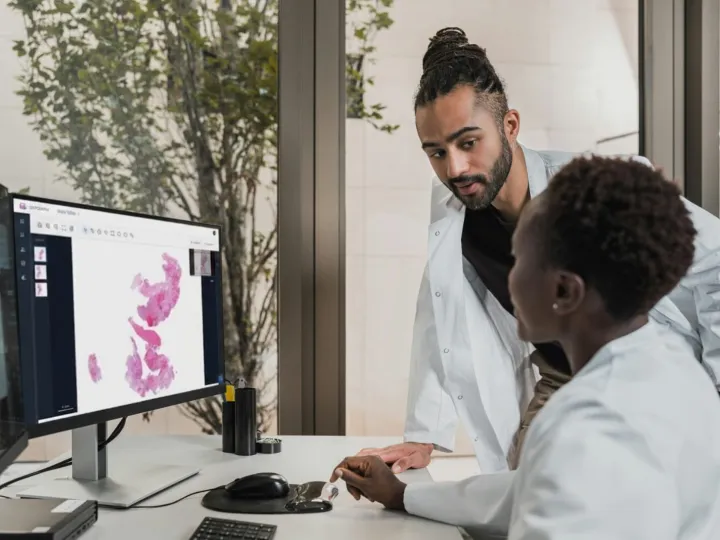
Two people wearing lab coats sit in front of a computer using the Octopath Ai model.

Breadcrumb trail

  1. Home
  2. News & views
  3. Octopath AI secures £1.5 million to support cancer pathology

New UCL spinout Octoapth AI has raised £1.5m in combined seed and grant funding to develop its AI-powered digital pathology analysis models. 

The investment is led by TwinPath Ventures, and the launch coincides with National Pathology Week. The company has also secured a £500,000 Innovate UK grant, unlocked on a matched basis by the investment. The funding will support clinical evaluation, product development and work towards regulatory approval. 

Octopath AI was born out of research from UCL’s Department of Medical Physics and Biomedical Engineering, founded by Dr Zhuoyan Shen, Dr Charles-Antoine Collins Fekete and Dr Esther Bär. The technology is designed to work alongside pathologists, supporting their important role in the patient diagnostic journey.  

Their analysis models, Kraken and Nemo, analyse routine tissue slides at single-cell resolution in under two minutes, generating measurements including cell counts, densities and spatial relationships. This gives pathologists more information in less time, capturing detail that would be impractical by eye. For example, manually estimating tumour cell density takes around 20 minutes per slide.  

The platform can analyse every cell, rather than relying on estimates from selected areas, having been trained on more than 14 million individually-labelled cells across 14 cancer types.  

The models are trained using ‘spatial-omics’ data – measurement of biological molecules such as RNA, proteins or metabolites, while preserving precisely where those molecules sit within a tissue. 

UCL Ventures supported the team to protect the research, identify its market opportunity and connect them with investors. 

Helping pathology services do more with every slide 

The potential impact comes at a time when cancer services are under considerable pressure: in May 2026, more than 55,000 people in England waited longer than the NHS four-week standard to find out whether they had cancer. Meanwhile, only 3% of UK histopathology departments report having enough staff to meet clinical demand.  

For Dr Esther Bär, co-founder and Chief Executive Officer of Octopath AI, the opportunity is not simply to make existing analysis faster. It is to capture more useful information from tissue slides: “Pathologists are being asked to do more with the same slides and the same hours. The information we need is already there on the glass; it just never comes off it.  

“We built Octopath AI to get it out, in a form pathologists can trust and act on, without adding to their day.” 

Dr Anne Lane, Chief Executive Officer of UCL Ventures, said: “Octopath AI is a powerful example of UCL research being translated into a company with the potential to improve both patient care and the resilience of health services.”  

Testing the technology in practice 

Octopath AI is already testing its technology beyond the lab: the platform is deployed at five sites, including University College London Hospitals (UCLH), where it is processing around 200 anonymised slides a day. Samples from four clinical trials are also being assessed. 

The team is exploring applications including tumour grading, immune-cell mapping, cellularity, blood-vessel analysis and biomarker scoring. 

Billy Lam

Business Manager

Billy Lam is apart of the Physical Sciences and Engineering team, where he focuses on the commercialisation of medtech, healthcare engineering, medical imaging and AI-enabled healthcare innovations arising from UCL research.

He supports academics in identifying protectable inventions, developing IP strategies, assessing market opportunities and shaping translational plans for early-stage healthcare technologies. Billy brings experience across academic, commercial and government sectors, with a strong background in innovation management and intellectual property commercialisation.

Before joining UCL Ventures, he worked as an IP consultant to startups, supporting invention capture, IP portfolio management and commercialisation strategy from early-stage R&D through to investor and partner engagement.

UCL Ventures footer

About UCL Ventures

  • Our people
  • What we do
  • Who we are
  • Our culture

Forms & Resources

  • Publications and downloads

Accreditations

  • Cyber essentials
    cyber essentials logo
  • Living wage
    living wage employer logo
UCL Ventures

UCL Ventures Limited (Company Registration No: 02776963) is a wholly-owned subsidiary of University College London. 

Registered office: 
University College London
Gower Street
London
WC1E 6BT

UCL social media menu

  • Link to Linkedin
Back to top

Legal

  • Cookie policy
  • Freedom of information
  • Privacy policy
  • Rules of website use

© 2026 UCL Ventures Limited