

Professor Rajiv Jalan & Yaqrit - journey to market
Professor Rajiv Jalan (UCL Institute for Liver and Digestive Health) is a world-leading clinician–scientist in hepatology.
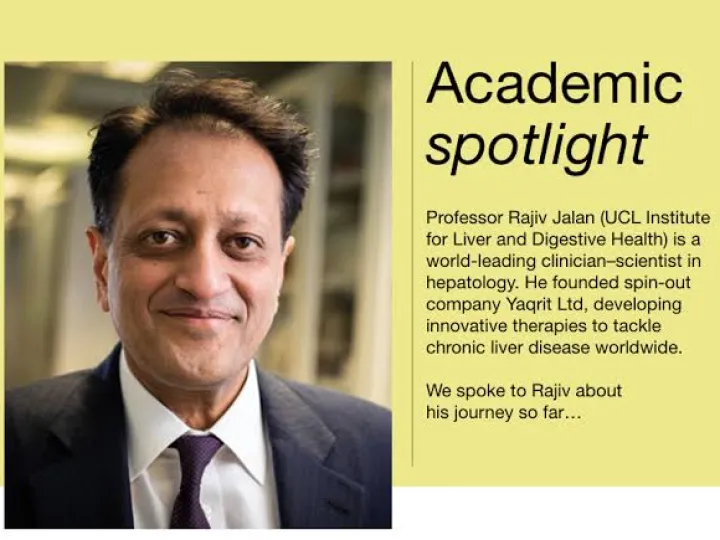
He founded spinout company Yaqrit Ltd, developing innovative therapies to tackle chronic liver disease worldwide. He spoke about his journey for the Academic Spotlight feature in the UCL and India brochure, which explores the ongoing close relationship between the university and the sub-continent.
Professor Jalan’s interview
Tell us more about your background and connections to India.
I grew up in Kolkata, India, and moved to the UK after completing medical school and working as a senior house officer and gastroenterology fellow. I trained in gastroenterology and internal medicine in Liverpool, before becoming the first registrar at the Scottish Liver Transplantation Unit in Edinburgh. I was fortunate to be mentored by two outstanding hepatologists, Professor Peter Hayes and Dr Niall Finlayson, who helped me develop my expertise in liver disease.
I completed my MD on transjugular intrahepatic portosystemic shunt (TIPS), a novel intervention for severe portal hypertension. Roles in Hammersmith, Edinburgh, and the Netherlands laid the foundation for my work as a translational hepatologist, before I was recruited to UCL by Professor Roger Williams. Within my first year, I identified and named a new condition: acute-on-chronic liver failure (ACLF). Over the past 25 years, I’ve helped define its diagnostic and prognostic criteria. Today, ACLF is globally recognised, with over 5,000 publications and more than 500 active researchers.
I’ve maintained strong collaborations with colleagues in India, particularly at AIIMS UCL and PGIMER Chandigarh – both outstanding institutions. I’ve recently built links with the Institute of Liver and Biliary Sciences (ILBS), New Delhi, India’s premier liver institute.
How did you become interested in haematology?
As is often the case, my interest was sparked by the enthusiasm and mentorship of those around me. My mentors’ guidance inspired me to pursue hepatology – a field that at the time was vast but poorly understood. The intrigue of exploring uncharted territory and the possibility of contributing to new discoveries convinced me to dedicate my career to liver disease research.
Could you share some highlights of your research at UCL?
As a clinician–scientist with a strong focus on translational research, I divide my time between patient care as a hepatologist and running a basic science–translational laboratory.
My overarching goal is to develop new therapies for liver failure. One of our most important findings has been demonstrating the causal role of systemic inflammation in driving organ failure in cirrhosis. This discovery formed the basis for describing and validating ACLF as a distinct syndrome with unique pathophysiological, clinical, and prognostic features.
My translational research now focuses on the molecular mechanisms of ACLF and developing novel therapeutic approaches. This programme has been supported by over £40m in grant funding, leading to many innovations including a compound called ornithine phenylacetate for treating ACLF and development of AI-driven digital therapeutic platforms, two of which are now in pivotal trials. All of our innovations are patent-protected and licensed into UCL spin-off companies.
You founded Yaqrit Ltd – can you tell us about the company?
Yaqrit was founded in 2014 as a UCL spin-out, built on intellectual property arising from my research into ACLF. At the time, all programmes were at the preclinical stage. Today, Yaqrit has five advanced development programmes, such as an intravenous therapy for hepatic encephalopathy and the DIALIVE extracorporeal liver assist device, which has received European safety certification and is about to begin Phase 3 trials in the UK.
What support has UCL provided and what are the next milestones?
UCL has been instrumental in supporting the development of [Yaqrit](https://yaqrit.com/). UCL Ventures provided essential help with intellectual property protection, licensing, and spinout formation. They offered mentoring in business development, seed funding, and vital introductions to industry partners. Without this infrastructure, Yaqrit could not have reached its current stage.
Our next milestones will be bringing our therapy for hepatic encephalopathy through Phase 3 trials and to patient; completing Phase 3 trials of DIALIVE and launching it; advancing our microbiome-based therapeutic through registration trials for cirrhosis and IBS; and publishing the results of our global liver transplant study in ACLF. Early findings show that ACLF patients benefit significantly and should be prioritised on waiting lists.
Tell us how you are working with Indian partners.
India combines world-class clinical care, hospital infrastructure, and a large patient base with a growing community of young, motivated researchers. We are now recruiting Indian patients into academic and clinical trials. On the industry side, India has become a global leader in pharmaceuticals and manufacturing. We are actively exploring manufacturing in India, with the aim of scaling access.
What advice would you give to young scientists and entrepreneurs?
It is, in my view, one of the most exciting paths one can take. The road is not easy – discovery is always challenging and often unpredictable. But the rewards of contributing to science, improving patient lives, and seeing your work make an impact are incomparable. Looking back, I would not change a single aspect of the journey.
—
You can view the full UCL and India brochure [here](https://www.ucl.ac.uk/global/sites/global/files/ucl_india_2025.pdf).
If you have an idea you would like to get an expert opinion on, [get in touch for a confidential discussion](https://www.uclb.com/contact-us/find-your-business-manager/).