Echopoint Medical: faster, more accurate heart disease diagnosis
A new cardiovascular medical device will enable patients to receive faster, more accurate diagnoses and better treatment.
Problem to be solved
Cardiovascular disease is one of the leading causes of death in the UK, and accurate diagnosis is essential for patients with chest pain to receive the right treatment. Yet many people - particularly women and people with diabetes - can be poorly served by existing diagnostic tools.
Around two-thirds of patients do not fit the ‘classic’ picture of a single blocked or narrowed artery that can be treated with stenting alone; instead, disease can be more complex and diffuse, affecting smaller vessels.
As Dr. Finlay says: “These patients have been underserved for many years. There’s a pressing need to provide precise, robust measurements that can support better diagnosis and treatment.”
Solution
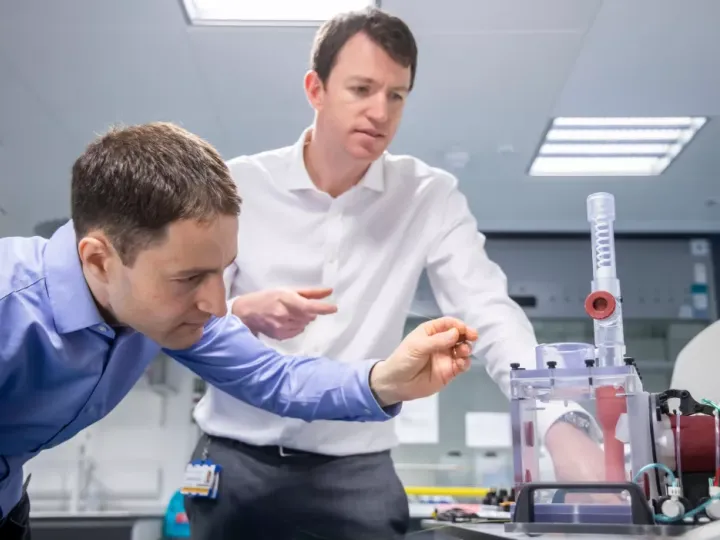
Echopoint Medical emerged from close collaboration between UCL engineers and clinicians, including Professor Desjardins and Dr. Colchester (Medical Physics and Biomedical Engineering), Professor Papakonstantinou (Electronic and Electrical Engineering) and Dr. Finlay (Consultant Cardiologist, Barts Heart Centre). The team is integrating fibre optic sensing into minimally invasive devices to extend the ‘sense of touch and vision’ inside the body and deliver new measurements during procedures.
Optical fibres - widely manufactured at scale for telecommunications - are thin, flexible, biocompatible and immune to electromagnetic interference, making them well suited to clinical devices. Echopoint has developed a proprietary microcatheter to deliver its sensors, algorithms to interpret the sensor data and a console with a real-time display, designed to be compatible with existing clinical practice. As Professor Desjardins explains: “A key technical challenge has been the microfabrication of advanced sensor head elements that are positioned at the distal ends of optical fibres.”
How UCL Ventures helped
Moving from Proof of Concept to patient impact in MedTech requires specialist expertise, funding and careful planning for clinical and regulatory milestones. As Antony Odell, Echopoint’s Executive Chairman, explains: “We’ve realised how much of the journey lay ahead beyond the initial proof-of-concept stage. UCL Ventures helped to bring in the external expertise we needed and acted as a bridge to venture capital funding, which has been instrumental in making the next step.”
In September 2019, Echopoint raised £2.8m from the UCL Technology Fund (UCLTF), Parkwalk Advisors and Innovate UK, helping the company build momentum towards first clinical use. Weng Sie Wong, Senior Business Manager, UCL Ventures, adds: “MedTech can be a challenging sector, so it’s important to have the right expertise to navigate the hurdles and make projects attractive for investors. When you get it right, the rewards and impact are enormous, and for a company like Echopoint the benefits could be felt by huge numbers of patients globally.”
Where is Echopoint now?
A first-in-human trial is underway at Barts Heart Centre in London - a major milestone on the path to regulatory approval. The team has its sights set on a global opportunity estimated to be in excess of $1bn, and plans a further funding round to grow the core team and deepen relationships with suppliers and international partners.
In 2026, EchoPoint Medical secured a $2.5m investment round led by Parkwalk, with participation from UCL Technology Fund. This funding will support the company’s next phase of development, including progression towards FDA submission and the initiation of its US clinical programme to generate real-world evidence for its iKOr system.
EchoPoint Medical is developing technology to enable more comprehensive and consistent assessment of coronary physiology. The company’s iKOr platform is designed to measure coronary blood flow and pressure, providing clinicians with a rapid, integrated view of both macrovascular and microvascular function, areas that are often difficult to assess using existing tools.
The investment marks a significant step forward as the company moves towards clinical validation and broader adoption, with the potential to improve the diagnosis and management of coronary microvascular disease.
David Grimm, Investment Director at UCLTF, says: “This is a great combination of fantastic UCL engineering talent, expert clinician input and experienced management taking some super impressive tech and applying it to solve a pressing need. This is the sort of innovation the UCL Tech Fund loves to support and we’re proud to be working with Echopoint.”