

World AI Week: how UCL founders are putting AI to work
From surgery to data centres, UCL Ventures’ spinouts are using AI to transform lives
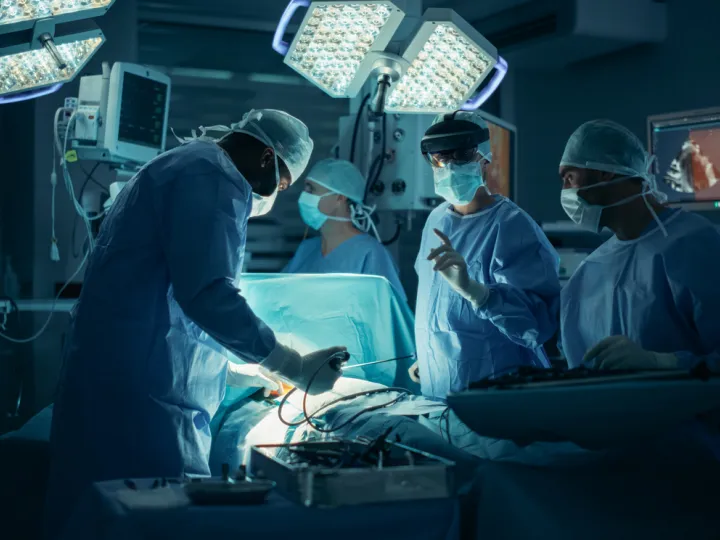
This Global AI Week (5-9 October) we are highlighting the world-changing AI-assisted inventions and technologies coming out of UCL which are changing lives for the better, while celebrating the academic entrepreneurs creating spinouts to bring them to life, and to market with the help of UCL Ventures.
UCL researchers are using AI to change lives, from helping surgeons driving efficiency in clinical decision-making, to supporting clinicians to diagnose rare diseases faster, optimising supply chains, and making gaming more accessible for disabled users.
AI for better health
Rare inherited eye diseases often take years to diagnose, but Eye2Gene uses AI to analyse thousands of retinal scans to predict which genes may be responsible for a patient's condition; this helps clinicians prioritise genetic testing and move patients towards treatment faster.
Founded by Associate Professor Nikolas Pontikos (UCL Institute of Ophthalmology), Eye2Gene’s recent research showed the spinout is achieving more than 80% accuracy in identifying disease-causing genes from retinal imaging.
Eye2Gene acts like a highly-trained pattern-matcher. Its deep-learning system was developed using almost 2,500 patient records and tens of thousands of images gathered at Moorfields Eye Hospital. These include surface photographs, infrared scans and optical coherence tomography, which produces cross-sectional views of the retina.
Ultimately, Eye2Gene aims to use data-driven decisions for detection of certain inherited eye conditions, getting sight saving treatments to patients earlier.
Neurosurgery is a discipline that often requires operating in extremely confined spaces. Panda Surgical has developed next-generation handheld robotic tools for neurosurgeons to perform complex minimally invasive procedures.
The robotic devices feature exchangeable wristed surgical instruments accompanied by AI-powered software which aims to assist during surgery - increasing the neurosurgeon’s dexterity and decision-making, allowing them to reach previously unattainable areas and perform delicate manoeuvres safely and precisely.
Founded by Dr. Manios Dimitrakakis, Professor Danail Stoyanov (UCL Computer Science) and Professor Hani Marcus (UCL Queen Square Institute of Neurology), Panda recently secured £378,000 in Innovate UK funding to develop an AI assistant for robotic neurosurgery that helps surgeons maintain orientation in complex procedures.
AI is also enhancing cancer detection. Early signs of bowel cancer can be difficult to detect during endoscopy, and Odin Vision is using cloud-based AI systems to support clinicians by highlighting suspicious polyps and abnormalities during procedures.
Founded by Professor Danail Stoyanov and Professor Laurence Lovat at the UCL WEISS Centre for Interventional & Surgical Sciences, Odin Vision (acquired by Olympus in 2022) is working to bring AI-assisted cancer detection to clinical settings globally.
AI for industry
AI is also prompting a revolution in optimising the systems that keep society moving.
Large organisations face enormously complex logistical and operational decisions, and Satalia’s AI optimisation systems are helping businesses allocate resources, schedule staff and manage logistics more efficiently.
Founded by Dr. Daniel Hulme, Professor Sir Anthony Finkelstein, and Dr. Alastair Moore from UCL Computer Science, Satalia has expanded its AI-powered delivery optimisation work with major retailers including Waitrose and DFS. Deployment of their technology has seen reported savings of over £1m through improved routing and scheduling.
Navigating unpredictable real-world environments is another promising AI application. Stanhope AI’s neuroscience-inspired AI is built around principles of human cognition and decision making.
Stanhope AI is developing "active inference" AI which works in a different way to conventional AI learning that relies on large, fixed datasets. Stanhope's technology uses a combination of neurology and computer science to 'mimic' decision-making in real-life situations - reacting to stimuli and information in real time rather than relying on databases.
Founded by Professor Karl Friston from the UCL Queen Square Institute of Neurology, with Professor Rosalyn Moran and Dr. Biswa Sengupta, StanhopeAI is aiming to apply its autonomous decision-making technology to hardware that could have applications in hazardous or extreme environments.
Making technology more accessible and impactful
Creating professional video content is expensive and time-consuming. Synthesia’s AI-generated avatars and video creation tools help organisations produce content quickly and at scale.
Co-founded by Professor Lourdes Agapito from UCL Computer Science, Synthesia reached a reported valuation of approximately $4bn following a major funding round and continues to expand into interactive AI avatars and enterprise communication tools.
Lastly, MotionInput Games is bringing traditional computers and gaming systems to disabled and neurodivergent users, for whom the technology can be inaccessible.
The spinout’s webcam-based AI tracks body movements, gestures and facial expressions, allowing users to interact without conventional controllers.
Founded from research led by Professor Dean Mohamedally in UCL Computer Science, the company recently launched MotionInput Football Practice, designed with the National Autistic Society to support accessible participation around the 2026 World Cup.
UCL Ventures supports all these diverse spinouts throughout their journey. Our specialist teams work with academics to protect intellectual property, assess commercial opportunities, build strong business plans and founding teams, establish new companies and agree licensing arrangements.
We also connect spinouts with experienced leaders, investors and funding, providing tailored support as they grow and take their ideas to market.
As AI continues to evolve, UCL founders are demonstrating its potential to help people achieve more than ever before.