UCL Ventures Navigate back to homepage
Find your Business Manager

Main navigation

  • Your route to market

    Your route to market

    We guide UCL academics, researchers and clinicians to get their research to market.

    Disclose an idea
    • Getting started An introduction to commercialisation and next steps
    • Our collaborative approach How we work with you to get to market
    • What you can expect Demystifying the process of commercialisation
    • Options to move forwards Explore the different pathways to market
      • Protect your idea
      • Create a company
      • Licensing your invention
      • Routes to social impact
    • Funding & support The financial and practical help that we can offer
      • Help managing your project
      • Training & tools
      • Common questions
  • Explore innovations

    Explore innovations

    Our portfolio and technologies span AI and quantum, to gene therapies to consumer products.

    • Spinout portfolio Browse our portfolio of spinout companies, based on UCL research
    • Our expertise & pipeline The sectors we span and therapeutics in development
    • Social Ventures Ventures driving impact in communities
    • License a technology Opportunities & collaborations with UCL's world-class research
  • Global impact

    Global impact

    How UCL research is changing the way the world lives, works and thrives.

    • Current page: Inspiring stories Real-world impact and successes, supported by UCL Ventures
    • Impact Report Our annual report showcases how UCL research is going beyond the university
    • Supporting innovation at UCL Understand our role in the innovation ecosystem
  • Investors & business

    Investors & business

    Opportunities for collaboration across UCL's world-class research.

    • Why partner with UCL Ventures With over 30 years in commercialisation, we have a strong track record
    • Our portfolio View our spinout companies across all sectors
  • News & events

    News & events

    The latest news and events from our team and portfolio.

    • News & views Stay up to date with the latest insights and announcements
    • Events Where you can find us across UCL and external events
  • Get in touch

    Get in touch

    Contact our team of experts for all your queries and needs.

    • Speak to the team Choose your enquiry type to reach the right team
Find your Business Manager

Cascader: developing AI to spot problems in the eye, and beyond

Analysing millions of eye scans to offer earlier diagnosis, and a window into wider health concerns.
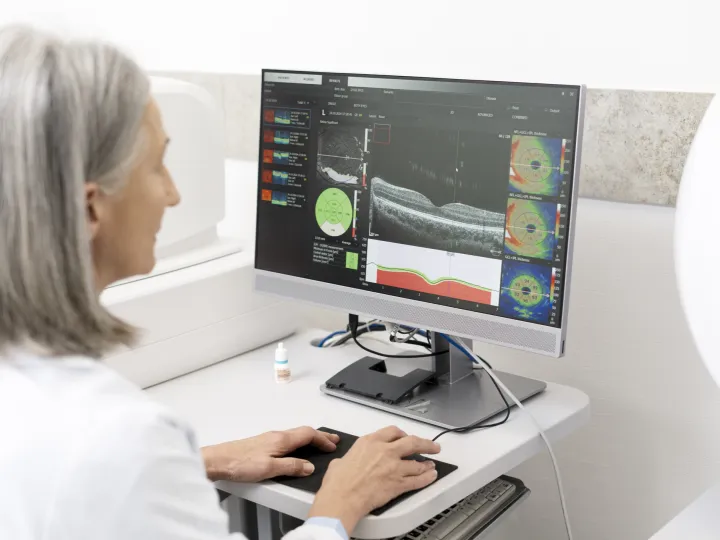
Senior female doctor analysing optical coherence tomography (OCT) scans on a computer

Breadcrumb trail

  1. Home
  2. Inspiring stories
  3. Cascader: developing AI to spot problems in the eye, and beyond

Problem to be solved

Optical coherence tomography (OCT) scans generate highly-detailed images of the different layers of cells that make up the retina. It is a widely used technology to diagnose retinal disease. 

The challenge is interpreting this growing volume of complex data into information clinicians can use quickly and confidently. Identifying potentially sight-threatening disease early means patients can be referred for the right care sooner.

Demand is also increasing: hospital outpatient attendances for vision problems in England reached almost 10.7 million in 2024/25, 38% higher than in 2013/14. For conditions such as age-related macular degeneration (AMD), delays in diagnosis and treatment can lead to irreversible sight loss. 

Clinicians therefore need reliable ways to identify important changes in retinal scans and make evidence-based decisions at pace, without adding further pressure to already stretched eye-care services.

Solution

Cascader is developing artificial intelligence that analyses OCT scans to identify signs of eye disease and support clinicians in making decisions about referral and care. Its first products are focused on macular diseases, including AMD, where earlier detection and treatment can help prevent avoidable sight loss.

The technology builds on research from the UCL Institute of Ophthalmology and Moorfields Eye Hospital. In landmark work with Google DeepMind, researchers developed an AI system that could analyse OCT scans and recommend referral decisions for more than 50 sight-threatening eye diseases. Its performance was comparable to world-leading eye experts.

Working with UCL, Moorfields Eye Hospital and Topcon Healthcare, Cascader aims to support decision-making across the eye-care pathway, from community optometry services through to specialist hospital clinics.

Its technology has also drawn on RETFound, a foundation AI model trained on 1.6 million retinal images. The potential for the AI analysis of these ophthalmic images could extend beyond eye disease. Advances in oculomics are exploring how changes visible in the eye could provide information about conditions affecting other parts of the body, including the heart, brain and blood vessels.

How UCL Ventures helped

Turning a world-class research idea into a company that can attract investment and ultimately reach patients takes more than scientific excellence.

UCL Ventures worked closely with all stakeholders in this initiative to establish the company’s formation, working with UCL academics, Moorfields Eye Hospital NHS Foundation Trust and industry partners to turn the research into an investable spinout. 

Dr Mark Fisher, Associate Director, Biopharm at UCL Ventures, explains: “Cascader offers exciting potential in how AI can turn detailed eye scans into practical support for eye care specialists, helping them identify disease earlier, refer patients to specialist ophthalmology centres where clinicians can make informed decisions for those patients. Cascader demonstrates UCL Ventures’ role in working with academics, clinicians and partners to attract investment and build companies that can make a measurable difference.”

Where is Cascader now?

Cascader is now progressing towards bringing its first products to market.

In September 2026, the spinout achieved seed funding, helping accelerate the development of its first products and grow its team.

Cascader can also draw on resources of Moorfields' INSIGHT Eye and Oculomics Health Data Research Hub’s resources, a partnership which provides secure access to curated eye-health datasets and computing infrastructure. INSIGHT contains more than 35 million retinal images linked with clinical information. 

It is another step towards turning years of research into technology with the potential to make a meaningful difference to patients.

For Co-founder Professor Pearse Keane, Professor of Artificial Medical Intelligence at the UCL Institute of Ophthalmology and Consultant Ophthalmologist at Moorfields, that ambition comes back to a very human outcome: “Our AI will lead to earlier diagnosis and earlier treatment, saving people’s sight, both in the UK and around the world.”

Team

Professor Pearse Keane

Founder and Chief Medical Officer

Professor Keane is an expert in eye-related artificial intelligence and Oculomics. He helped create RETFound, the first major model for eye care, and has shaped the area of Oculomics.

  • LinkedIn

Dr. Mark Fisher

Associate Director

Dr Fisher has management responsibility for the BioPharm patent portfolio and strategic business support for the BioPharm team. At the coalface, Mark manages the commercialisation of technology from the Institute of Ophthalmology and Moorfields Eye Hospital UCL Global Business School for Health and the Department of Ageing, Arthritis and Regenerative Medicine.

He holds a first degree in Industrial Biology and a PhD in Biochemistry and Molecular Biology from UCL, in association with one of the first biotechnology companies to be established in the academic sector.

Mark brings more than 30 years of experience in life sciences and healthcare licensing, new company development and securing investment from both the public and private sectors to his team. To date, Mark has been responsible for the establishment of more than 25 new businesses in diagnostics, drug discovery, medical devices and therapeutics.

As a certified lead auditor of ISO 13485, Dr Fisher has additional experience in quality management systems and the translation of technologies from research and design into manufacture at home and abroad.

Mark is a Freeman of the Worshipful Company of Management Consultants and gained the Freedom of the City of London in 2010 for his contribution to the economy through new business development.

  • LinkedIn

UCL Ventures footer

About UCL Ventures

  • Our people
  • What we do
  • Who we are
  • Our culture

Forms & Resources

  • Publications and downloads

Accreditations

  • Cyber essentials
    cyber essentials logo
  • Living wage
    living wage employer logo
UCL Ventures

UCL Ventures Limited (Company Registration No: 02776963) is a wholly-owned subsidiary of University College London. 

Registered office: 
University College London
Gower Street
London
WC1E 6BT

UCL social media menu

  • Link to Linkedin
Back to top

Legal

  • Cookie policy
  • Freedom of information
  • Privacy policy
  • Rules of website use

© 2026 UCL Ventures Limited