

I-O Converse: interview with Phasecraft Co-founder, Toby Cubitt
Professor Toby Cubitt is the CTO and co-founder of Phasecraft, a quantum algorithms spinout designing quantum algorithms that can work on today’s hardware.
Collaborating with hardware leaders like Google Quantum AI and IBM, Phasecraft has raised $50m in funding to realise the benefits of super-complex quantum computing.
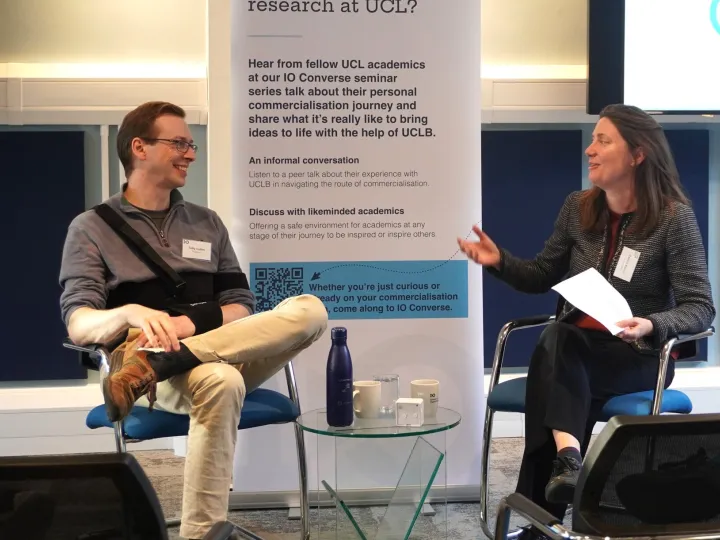
Professor Cubitt, who also teaches at UCL Computer Science, talked to Senior Business Manager, Dr Celine Baron, at UCL Ventures’s recent I-O Converse event (24th February, 2026) to reflect on his journey from theoretical academic research to building a deep-tech startup.
What is Phasecraft and what does it do?
We describe Phasecraft as a ‘quantum algorithms company’. That distinction matters, because we’re not a hardware company. We’re not building quantum computers.
We focus on how to get useful, real-world applications running on the quantum hardware that already exists. That’s a major research challenge, because currently no one really knows how to do this reliably.
What real-world problems could Phasecraft technology solve?
There are two broad areas. The first is materials modelling and computational chemistry. This goes back to Richard Feynman’s insight in the 1980s: nature isn’t classical, so simulating quantum mechanics properly requires a quantum computer.
This matters enormously for industry. Modern batteries, photovoltaics, and advanced materials rely on quantum-mechanical effects that classical computers often struggle to model accurately. If you want better batteries or new materials, being able to simulate those systems correctly is hugely valuable.
People often mention drug discovery, and there *is* potential there, but it’s important to be realistic. Quantum computing might help with the very early-stage simulation of biochemical processes.
The second area we work on is optimisation. These problems are everywhere: logistics, manufacturing, scheduling, recommendation systems. The range of applications is enormous.
What motivated you to spin out from academia?
Around 2018-2019, something changed: quantum computers stopped being lab toys and started becoming real machines that could do things classical computers couldn’t. People in the field knew that companies like Google were close to demonstrating this, and suddenly the field shifted from pure research to the beginnings of a new technology.
At that point, I felt I had a choice: I could stay on the sidelines in academia and comment on what industry was doing — or I could get involved in actually building the technology. For me, the second option was far more exciting.
How important is your founding team?
My strongest advice to anyone considering forming a spinout is: choose your co-founders carefully. Professor Ashley Montanaro (University of Bristol) and I had worked together for years and published many papers together. He’s one of the world’s leading researchers in quantum algorithms, and we complement each other well. I joke that I taught him physics and he taught me computer science.
Professor John Morton (UCL’s London Centre for Nanotechnology) is an experimental physicist and had already helped take another quantum company, Quantum Motion, through an early funding round. He brought invaluable experience from being a step or two ahead of us in the startup journey, especially on the business side.
We’re very different personalities, we disagree constructively about almost everything, but we’ve never fallen out. That balance has been crucial.
What was the biggest adjustment moving from academia to a spinout?
What *was* a shock was how different the ecosystem is. Academia has its own rules, language, and incentives. VC-backed startups are an entirely different world, with different expectations and pressures.
One major shift is how you think about money. In a pre-revenue startup, investors want you to spend money to move fast. If it helps you reach the next milestone, you should do it.
What advice would you give to academics considering commercialisation?
First, be honest about your motivation. Founding a startup is exciting, but it’s also incredibly hard work. There are many ways to commercialise research – licensing, partnerships, consultancy – and all of them are valid. If you do want to start a company, go in with your eyes open. You’re not just doing research anymore, you’re building everything: hiring, finance, fundraising, culture.
I wish I’d understood more about fundraising, term sheets, and founder equity earlier on. That knowledge would have reduced stress. But realistically, a lot of this can only be learned by doing. Experience is the best teacher, even if it’s painful at times.
About I-O Converse
I-O Converse is part of I-O (Ideas to Opportunities), UCL Ventures’s programme supporting researchers to translate ideas into impact. Find out more here.