
UCL Ventures Navigate back to homepage
Find your Business Manager

Main navigation

  • Your route to market

    Your route to market

    We guide UCL academics, researchers and clinicians to get their research to market.

    Disclose an idea
    • Getting started An introduction to commercialisation and next steps
    • Our collaborative approach How we work with you to get to market
    • What you can expect Demystifying the process of commercialisation
    • Options to move forwards Explore the different pathways to market
      • Protect your idea
      • Create a company
      • Licensing your invention
      • Routes to social impact
    • Funding & support The financial and practical help that we can offer
      • Help managing your project
      • Training & tools
      • Common questions
  • Explore innovations

    Explore innovations

    Our portfolio and technologies span AI and quantum, to gene therapies to consumer products.

    • Spinout portfolio Browse our portfolio of spinout companies, based on UCL research
    • Our expertise & pipeline The sectors we span and therapeutics in development
    • Social Ventures Ventures driving impact in communities
    • License a technology Opportunities & collaborations with UCL's world-class research
  • Global impact

    Global impact

    How UCL research is changing the way the world lives, works and thrives.

    • Inspiring stories Real-world impact and successes, supported by UCL Ventures
    • Impact Report Our annual report showcases how UCL research is going beyond the university
    • Supporting innovation at UCL Understand our role in the innovation ecosystem
  • Investors & business

    Investors & business

    Opportunities for collaboration across UCL's world-class research

    • Why partner with UCL Ventures With over 30 years in commercialisation, we have a strong track record
    • Our portfolio View our spinout companies across all sectors
  • News & events

    News & events

    The latest news and events from our team and portfolio

    • Current page: News & views Stay up to date with the latest insights and announcements
    • Events Where you can find us across UCL and external events
  • Get in touch

    Get in touch

    Contact our team of experts for all your queries and needs

    • Speak to the team Choose your enquiry type to reach the right team
Find your Business Manager

Autolus founder discusses the long journey from research to impact

Academic-turned-founder Dr. Martin Pule spoke about the realities and rewards taking cancer therapies to market at I-O Converse.
10 July 2026

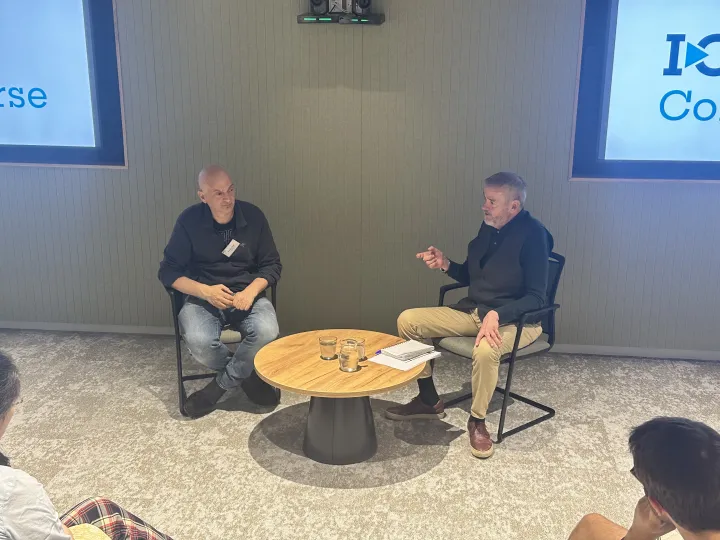
Dr Martin Pule talks to Dr Rick Fagan in front of a crowd at I-O Converse

Breadcrumb trail

  1. Home
  2. News & events
  3. News & views
  4. Autolus founder discusses the long journey from research to impact

Autolus Therapeutics’ pioneering cancer therapies began life in the labs at UCL Cancer Institute and the Great Ormond Street Institute of Child Health. The company’s CAR T-cell therapy, obe-cel, was developed by Dr. Martin Pule and collaborators to treat patients with acute lymphoblastic leukaemia – but is today being applied to help people with multiple sclerosis (MS) and lupus. 

The company spun out in 2014, with UCL Ventures’ support including managing intellectual property (IP) and forming the company; this laid the foundations for what would become a global biopharmaceutical company. 

The NASDAQ-listed company has raised more than $1.1bn of investment capital and opened The Nucleus, a state-of-the-art manufacturing facility in Stevenage. 

Dr. Pule spoke to UCL Ventures’ Director of Biopharm, Dr. Richard Fagan at our I-O Converse event in June. Through informal and candid discussions with founders and collaborators, the series explores the practical realities of building ventures from university research.

Reflecting on the contrast between academia and industry, Dr Pule was open about the long road from research insight to patient impact, and the lessons he has learned building a company around complex biomedical science.

How do academia and industry compare?

"They’re very different environments. In industry, you are not spending your time writing grant applications. Instead, you are persuading a board or investors to commit resources, and if they do, you can move quickly: build teams, scale programmes and make decisions at pace.

Academia has different pressures, but also different freedoms. Because you are not immediately focused on revenue, you can pursue more speculative or unconventional ideas, the kind of blue-sky research that might feel too risky in a commercial setting. 

The two systems are complementary – academia is very good at generating bold ideas, while industry is essential for developing them at scale.”

Why was the relationship between UCL, UCLH and Autolus so important?

"For therapies like CAR T, the clinical development pathway is extremely complex. Early-phase, first-in-human trials require world-class clinical expertise, robust manufacturing, and careful regulatory work. 

UCL has been particularly strong in the underlying science and translational research, while UCLH provided deep clinical capability.

That combination mattered enormously. Autolus could take the science forward as a company, but it was built on a network of academic, clinical and commercial expertise. You need all those pieces working together if you want to turn a promising invention into a therapy that can reach patients.”

When is the right time to start a company through your UCL Ventures Business Manager?

"Timing is determined by the invention. If you have something genuinely promising, I would not necessarily wait until the end of a PhD or the next academic milestone before thinking seriously about how to move it forward.

But starting a company is not the hard part. The hard part is attracting the investment and support needed to develop the idea properly. That process can take as long as finishing the PhD itself. 

So the question is less “should I incorporate now?” and more “is there real momentum behind this invention, and can it attract the resources it needs?””

How should academics think about intellectual property?

"It depends partly on your status. As a PhD student, you may own your own IP, while postdocs and employees will usually be covered by institutional ownership rules. But research is rarely isolated - most inventions come out of a collaborative lab environment, with input from supervisors, colleagues and others.

Being named on a paper does not automatically make someone an inventor. What matters is whether they made a genuine, inventive contribution, which is why it is important to involve the right commercialisation and IP experts early – like UCL Ventures – before ideas are widely shared.”

You’ve said before that ideas do not stay unique for long. What do you mean by that?

"I sometimes describe it as ‘mental vibrations’. If you have thought of something, there is a good chance someone else will too. It’s not mystical, it’s just how science progresses. People read the same literature, see the same problems emerging, and start moving in similar directions.

So, if you have a strong idea, do not sit on it indefinitely. Think carefully, protect it where appropriate, but move it forward. In competitive fields, you are unlikely to be the only person heading in that direction.”

What was it like navigating NICE and NHS access?

"It’s a demanding process. NICE evaluates therapies in terms of clinical benefit, cost effectiveness and quality-adjusted life years, and then negotiates on price. From a healthcare system perspective, that is important because it helps manage costs. From an industry perspective, it is challenging because the process is long, evidence-heavy and highly detailed.

For AUCATZYL, it required multiple rounds of analysis and input from a wide range of people, including clinical experts and patient advocates. 

Ultimately, the positive recommendation was not the result of any one intervention… It was sustained effort, strong data and a lot of people working through the evidence carefully.

The first NHS patient receiving the therapy shows why that effort matters. For a fast-acting cancer like relapsed or refractory B-cell ALL (acute lymphoblastic leukaemia), speed and access are critical. Obe-cel is designed to reprogramme a patient’s own T-cells so they can recognise and attack cancer cells, acting as a form of ‘living medicine’ after infusion.”

Should companies ever avoid difficult markets because of pricing pressure?

"We considered that at one point… But for us, it felt important to stay engaged in the UK. These decisions are never simple. There are global pricing dynamics to consider, including situations where the price in one market can influence expectations elsewhere.

The system is complex, and there is room for improvement, but if the goal is patient access, companies have to engage with that complexity rather than avoid it.”

How important is storytelling when communicating complex science?

"It is critical. Academics can sometimes get lost in the technical detail and forget that investors, partners and wider audiences need to understand the bigger picture: why the idea matters, why it is different, and how it can succeed.

A strong pitch needs to set out the unique value, the competitive landscape and a realistic timeline. Realism matters because experienced investors can spot over-optimism quickly. You need ambition, but it has to be credible. 

And you need feedback from mentors and people who have done it before.”

What advice would you give academics thinking about commercialisation?

"Think about patents early, ideally before sharing ideas widely in grant applications or presentations. Patent protection can be expensive, so you have to be selective, but if something is genuinely novel and valuable, early advice is essential.

More broadly, do not underestimate the scale of the transition. A company is not just a vehicle for doing more research. It involves fundraising, governance, hiring, culture, manufacturing, regulation and communication. It can be enormously rewarding, but it requires a different mindset.”

---

The Autolus journey shows what can happen when scientific discovery is supported by the right expertise at the right time. 

For academics considering their own next steps, Dr Pule’s experience underlines the importance of engaging early: protecting intellectual property, testing the commercial potential of an idea, and building the networks needed to move it forward. 

This is where UCL Ventures works side by side with researchers and clinicians, helping to translate promising science into ventures that can scale and reach patients, often bringing life-changing impact with it.

About I-O Converse

I-O Converse is part of I-O (Ideas to Opportunities), UCL Ventures’ programme supporting academics, clinicians and researchers to learn about how to translate ideas into impact. These sessions explore fellow academics navigated the journey from research to market, and what they learnt along the way. 

Find out more about the programme here. 

Team

Dr Martin Pule

Founder and Chief Scientific Officer

Dr Pule's is an Associate Professor in haematology. His research focuses on many aspects of genetic engineering of T-cells for cancer treatment.

Dr Rick Fagan

Dr. Rick Fagan

Director of BioPharm

Institute of Clinical Trials and Methodology

Dr. Fagan brings extensive cell biology, pharma and technology transfer leadership experience, including AstraZeneca, SanofiAventis and UCL Ventures. He holds a PhD from McGill University.

UCL Ventures footer

About UCL Ventures

  • Our people
  • What we do
  • Who we are
  • Our culture

Forms & Resources

  • Publications and downloads

Accreditations

  • Cyber essentials
    cyber essentials logo
  • Living wage
    living wage employer logo
UCL Ventures

UCL Ventures Limited (Company Registration No: 02776963) is a wholly-owned subsidiary of University College London. 

Registered office: 
University College London
Gower Street
London
WC1E 6BT

UCL social media menu

  • Link to Linkedin
Back to top

Legal

  • Cookie policy
  • Freedom of information
  • Privacy policy
  • Rules of website use

© 2026 UCL Ventures Limited